



Lack of individual character of a lit pavilion
In this case, the holder of a garden pavilion design equipped with a string of lights saw its registered Community design cancelled for lack of individual character, despite its appeal before the General Court of the European Union.
Thus, in a judgment of 23 July 2025 (CJEU, General Court, T‑54/24), the Court dismissed the appeal brought by the German company EveMotion GmbH against the decision of the EUIPO Board of Appeal (Case R 436/2023‑3 of 1 December 2023), which had itself upheld the decision of the EUIPO Cancellation Division granting the application for a declaration of invalidity of Community design No. 005490596‑0003, of which the company was the holder.
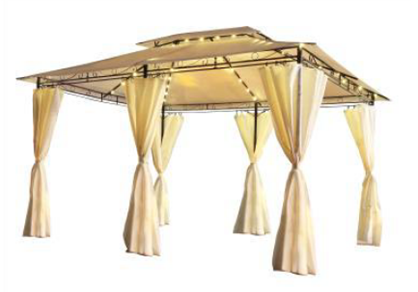
The contested Community design, filed on 9 July 2018, concerned a garden pavilion and was represented by the single view below:
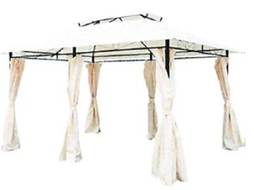
The application for invalidity was based in particular on an earlier Community design, disclosed no later than 7 March 2016 and represented as follows:
In support of its appeal, EveMotion GmbH relied on a single plea, alleging infringement of Article 6 of Regulation No. 6/2002 by the Board of Appeal, which had held that the pavilion design lacked individual character.
As one might have expected from the designs shown above, the German company mainly based its arguments on the importance of lighting in the contested pavilion design.
Unfortunately, this lighting was not considered sufficient by the Court, which essentially concluded the following:
The designer’s freedom in developing the pavilion was not limited,
In particular:
- a pavilion may take any conceivable basic shape (round, oval, rectangular, pentagonal…) and does not necessarily have to include movable side walls;
- the designer’s freedom is not limited due to technical requirements linked to integrating lighting into the roof structure; indeed, these light points, even when placed on the frame, may take various forms and be arranged in different ways;
- moreover, the specific shape of the power sockets cannot be taken into account, since such a feature is not visible in the representation of the contested design;
- the saturation of the state of the art cannot be considered as limiting the designer’s freedom.
There is no saturation of the design corpus in the pavilion sector,
The Court held that EveMotion GmbH had not provided the evidence—required from it—of the saturation of the state of the art in the pavilion sector (Internet searches from 2023 being too late relative to the 2018 filing date, and a few competitor pavilions being insufficient to prove real saturation). Neither was this a well‑known fact. Indeed, the circumstance that a particular type of pavilion was already known at the filing date cannot establish saturation of the state of the art in the relevant sector. Thus, the informed user would not be sensitive to minor differences between the conflicting designs.
The addition of a string of lights to the pavilion does not produce a different overall impression on the informed user between the contested design and the earlier design,
This is the central point of the judgment since, in practice, although other differences were acknowledged, the main question was whether the addition of string lights to the pavilion changed the overall impression, as argued by the German company, or whether it was merely an accessory element.
The Court held that these differences were barely perceptible in the submitted view and were not capable of producing different overall impressions.
Indeed, after recalling that all the features of the pavilion represented in the contested design—not only the lighting—must be taken into account when assessing individual character, the Court considered that:
- it is sufficient to note that, in the submitted view, the LED light points illuminating the pavilion are perceptible but not particularly visible or striking, and that the illumination or glowing effect produced by the lighting remains discreet;
- the role of the lighting is secondary and accessory compared to that of the pavilion itself, as the latter can be used during the day, when lighting is unnecessary. Under these conditions, the presence of integrated lighting can only have a minimal impact on the overall impression produced on the informed user;
- even if the German company had succeeded in demonstrating that, at the filing date of the contested design, the LED light‑point illumination of its pavilion was innovative and unusual, such circumstances would not be decisive since they concern a secondary and accessory element relative to the product as a whole;
- the wiring of the string lights is entirely concealed within the pavilion frame, so the pavilion structure remains fully visible;
- on the contrary, the main features remain: the general shape of the pavilion, the double roof, the hanging curtains, the six posts; thus, the other features of the pavilion are more numerous, more visible, and more striking than the LED light‑point illumination.
Thus, the Court concluded that the lighting of the pavilion represented in the contested design could not constitute the central and dominant feature of the contested design, and did not constitute a sufficiently significant and distinct difference capable, on its own, of producing a different overall impression from that of the earlier design. By holding that the similarities between the conflicting designs outweighed their differences, the Court confirmed that the contested design lacked individual character, and the appeal was therefore dismissed.
In conclusion, an accessory element such as a string of lights is not sufficient to individualise a pavilion whose structure is identical to an earlier design.
Even if the lighting of EveMotion GmbH’s design sheds no new light on how individual character is assessed for a Community design, this decision confirms that:
- the greater the designer’s freedom, the more pronounced the differences must be to create a distinct overall impression;
- accessory or atmospheric elements are insufficient to individualise a design;
- the assessment of individual character is based on what is shown in the submitted views, regardless of the actual use of the product to which it applies;
- where the designer’s freedom is broad, only substantial and immediately perceptible differences produce a different overall impression;
- the examination of evidence of saturation of the art in the relevant sector is very strict;
- without saturation of the art, only a notable difference may be sufficient to distinguish designs.
Design holders should therefore ensure that they:
- avoid relying on minor or concealed details as the basis for protection;
- clearly highlight, through multiple views, the differences from earlier designs;
- collect varied and dated evidence in the relevant product sector in order to demonstrate, where necessary, the saturation of the prior art at the filing date of the design.
By Laurence BONTRON, December 17, 2025
Illustration: Photo by David McEachan (Pexels)